

Botanical Embroidery Sweatshirt: Turn a Favourite Plant into a Personal Design
Sometimes the most personal design has no name or date. It is the sprig that reminds you of a familiar walk, the flower someone always kept on the kitchen table, or the plant you managed to keep alive in your first apartment.
A botanical embroidery sweatshirt gives that small memory a shape you can wear. For Canadians planning a personalised piece, the interesting question is not simply which flower looks pretty. It is which part of the plant—and which part of the memory—you want the design to carry.
You do not need a finished illustration to begin. A clear reference and a few thoughtful choices can help turn a loose idea into a useful creative brief.
Choose a plant for your own reason
Start with the connection before considering the composition. Write one sentence: “This is the herb we grew together,” or “These are the flowers that always appeared on her birthday table.” That sentence does not need to be embroidered. It helps you decide what belongs in the design.
You might choose a favourite garden plant, a familiar tree or a flower associated with a particular person. There is no need to borrow a symbolic meaning from a list if the plant already means something to you.
For a gift, make sure the connection belongs to the recipient too. A plant you love may not be the one they would choose. If you are uncertain, a short conversation about favourite flowers can reveal more than trying to infer their taste from one photograph.
Gather a reference that shows the important features
Use your own photograph or artwork you have permission to use. Choose an image where the plant is easy to distinguish from its background. A broad garden photograph can explain the setting, but a closer view is more useful for discussing the leaf shape or arrangement of petals.
Send a small, purposeful set: one image showing the overall form and another showing the detail that matters most. Explain what each reference contributes. Avoid presenting several different plants without saying which one you want interpreted.
If identifying the exact species matters, confirm it before writing the final brief. If the memory is about a general impression—a loose branch, soft petals or a cluster of leaves—say that instead. The designer should not have to guess whether botanical accuracy or a freer interpretation is your priority.
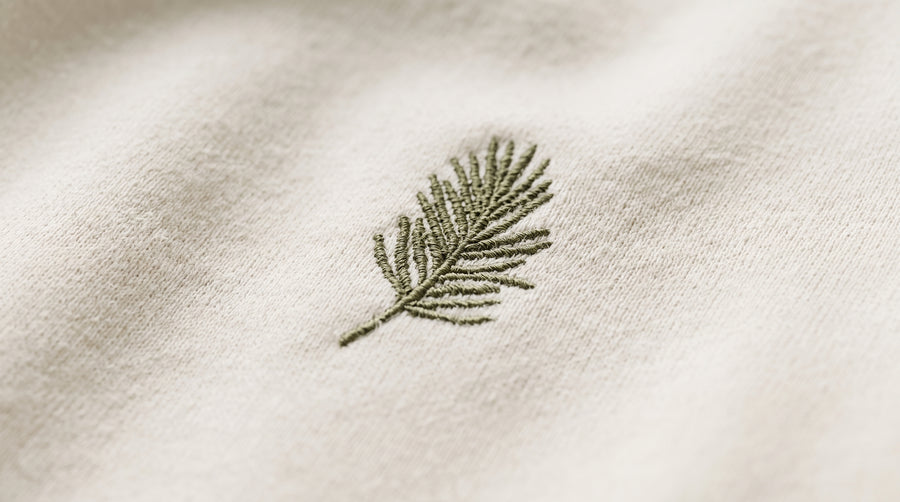
Decide what must survive simplification
Look at the reference and name two or three identifying features. Perhaps it is the long, narrow leaves, the way the stem bends or one flower sitting above the others. These become the details to protect when discussing a smaller interpretation.
Then identify what you are happy to leave out. Background foliage, an extra stem or every tiny variation in a petal may be less important than the overall silhouette. This is an editorial choice about the image you want, not a requirement to strip every design down to an outline.
Consider a hypothetical sweatshirt inspired by a windowsill herb pot. The meaningful detail might be a pair of upright stems, rather than the pot, the window frame and everything behind it. Removing the setting can make the plant itself the centre of attention.
Ask the embroiderer to review the proposed artwork at the intended size before deciding which details can be retained. A reference photo communicates your idea; it does not establish the finished embroidery specification.
Compare a sprig, a small cluster and a framed motif
The same plant can lead to quite different compositions. Choose the arrangement for the mood you want the sweatshirt to have.
- A single sprig: One stem or branch becomes the focus. Try it when the gesture of the plant is the detail you love.
- A small cluster: Several related elements create a fuller arrangement. Give one element a leading role so the others support it.
- A framed motif: A simple circle or another proposed border can make the plant feel like an emblem. Compare it with the unframed version before committing.
You can explore these on paper without producing polished artwork. Keep the same plant reference across the options so you are judging composition rather than getting distracted by a different flower in every sketch.
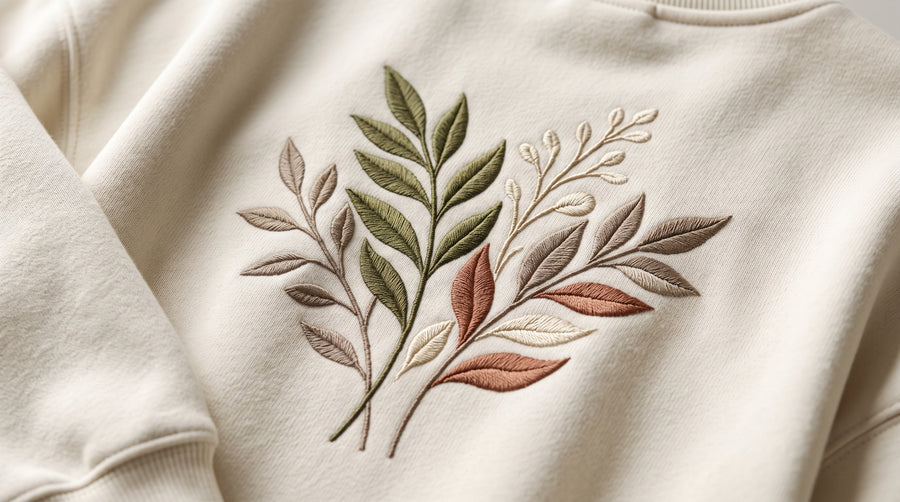
Let colour support the memory
A botanical design does not have to reproduce every colour in the photograph. Ask yourself whether the colour itself is meaningful. If a particular bloom is remembered for its warm terracotta tone, that may be central to your brief. If you mainly love the leaf shape, a restrained palette could express the idea.
Compare your preferred palette against the garment colour. Ivory around the motif, for example, becomes part of the composition even though it is not another stitched element. Leave room to judge the design as part of the sweatshirt.
Describe the mood as well as the colours: muted, lively, soft or graphic. Then ask how the actual thread choices will be confirmed. A screen reference helps start the conversation, but should not be your only instruction when a particular colour matters.
Write a brief that leaves room for a thoughtful interpretation
Bring the decisions together in a short request: “I would like a single botanical sprig based on my own photograph. Please preserve the curved stem and paired leaves. The background and pot can be omitted. I prefer a quiet green palette on a light crewneck; please advise on suitable dimensions and placement.”
Include whether you want an exact likeness or an interpretive design, and identify any detail you want reviewed before it changes. Our guide to embroidery proofs and stitch-outs explains how to approach the next approval step.
Explore Saffron & Pine as you gather your botanical inspiration, and confirm the possibilities for your particular project. For more visual ideas, follow Saffron & Pine on Instagram. The right plant does not need a grand explanation. Sometimes a small familiar branch says enough.